Light tower in cold weather: what the cold takes
The pack does not fail in the cold. It delivers less, and then it refuses to take a charge until it has warmed up, and that second half is the part that catches a winter shift.
The cold takes capacity first
A cell that is cold gives up a share of its rated capacity, and it does it without a warning. The lamp is fine, the station reports a normal output, and the shift ends with the tower dimming earlier than it did in September. Nothing has broken, and nothing on the display says why.
That is why a runtime figure belongs with a temperature note beside it. A station rated at 300 W continuous from 1000 Wh will not deliver the same night in January as in July, and a plan that multiplies capacity by hours without asking where the unit will stand is a plan for a summer site. The line this site prints on every battery page, that operating temperature is per data sheet, is the honest version: the range exists and it belongs in the quotation.
Charging is the limit, not running
Running a cold pack costs range. Charging a cold pack costs the pack, which is why the charger on most stations waits for the cells to come up before it pulls current. A crew that plugs a frozen station in at the end of the shift and finds it still empty in the morning has met that behaviour rather than a fault.
The practical answer is a warm charging window. Take the station indoors or into the site cabin and let it sit before it goes on charge. A pack charged at room temperature and carried out cold starts the shift with the capacity it was sold with.
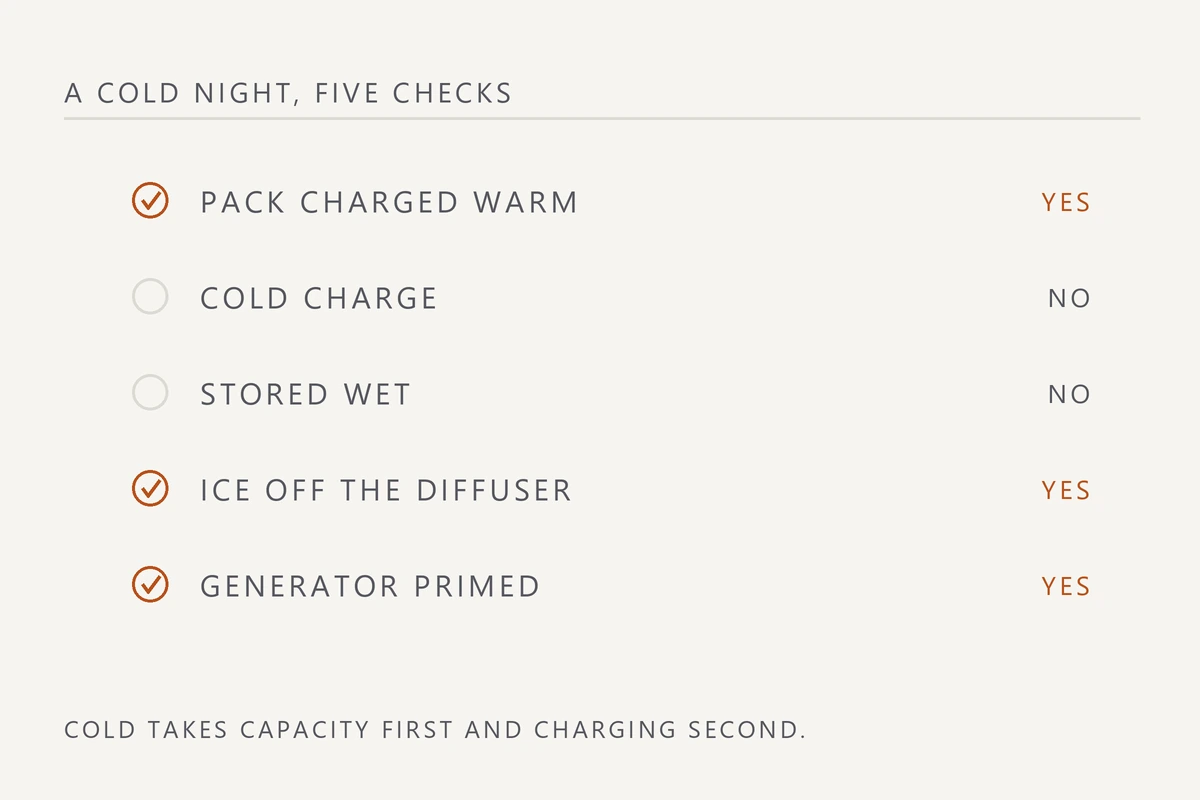
The five checks above are the whole routine. The two that fail are the two that cost a pack, and both of them happen when the unit is being handled by someone who is cold and in a hurry at the end of a shift.
Condensation, and where the unit sleeps
A cold unit carried into a warm room collects water on every surface, including the inside of the diffuser and the pins of the connector. The water is not a defect. Leaving the unit powered with it is.
Let the unit come up to temperature before it is switched on, and store it dry with the filter out. The filter is a service part on this line, and a wet filter becomes a blocked filter once it dries with dust in it.
Ice, snow and the diffuser
Ice on a balloon is weight on the head and a grey film over the light. Clear it before the shift rather than during it, and clear it by hand or with a soft brush rather than by knocking the head against the mast. A diffuser that has been struck cold is a diffuser with a crack that opens on the next warm day.
Snow load is the other half. A head carrying a cap of snow is carrying something it was not designed for, and the mast and the mount take that load as well. Clear the head before the mast goes up, and bring the mast down if the weather turns.
The generator alternative
A generator does not care about the cold the way a cell does, and it brings its own winter problems: an engine that is reluctant to start, fuel that has been in the tank since autumn, and a starter battery that is as cold as the station it was meant to replace. A generator tower is still the right answer on a site with no charging point.
The arrangement that works on a winter site is often the hybrid one. The generator runs during the day and charges the station, and the station runs the lamp at night with the engine off. The engine stays near the cabin where somebody can hear it, and the light stays where the work is.
What to write into the brief
| Question | What to ask for | Why it matters |
|---|---|---|
| Operating range | The stated temperature range for the station, not the lamp | It is the station that stops first |
| Runtime at the cold end | Hours at the lowest temperature the site sees | The summer figure is the wrong figure |
| Charging window | Whether the charger waits for cell temperature | It decides the shift pattern in winter |
| Storage | Whether the unit can live in an unheated container | Condensation is a storage problem first |
| Cold start | Whether the head and the generator start cold | A lamp that will not strike is a dark site |
Two of those five answers sit on a data sheet and three are questions for the supplier. A quotation that arrives with all five answered is a winter plan; one that arrives with a runtime and a wattage is a summer one.
Cold is a planning problem before it is a hardware problem. The tower that works in January is the one whose charging window was thought about in October.
Updated 2026-10-28 · 4 min read. Specifications change without notice; confirm the current sheet before you publish a claim or write a tender document.
Questions that come back
Short answers, before the email.
Does a battery tower work below freezing?
It runs and it delivers less. The cells give up a share of their capacity and the charger normally waits for them to warm before pulling current, so the shift is shorter and the recharge is slower.
Can I charge a frozen station?
Not usefully. Most chargers hold off until the cells are above a minimum temperature, so a frozen unit sits on the charger without taking a charge. Warm it first, then charge it.
Is a generator better in winter?
It is less affected by cold cells and more affected by cold fuel and a cold engine. Many winter sites run both: the generator charges by day and the station lights the night.
What happens to the diffuser in snow?
It collects snow and ice, which cuts output and adds weight to the head and the mast. Clear it before the mast goes up, and clear it by hand rather than by knocking it.
How do I find the real cold weather runtime?
Ask for hours at the lowest temperature the site sees, for the lamp being bought. A runtime quoted at room temperature is a summer number.
Send the site, get the configuration.
Head, mount, power and the specification sheet for each line item, in one reply.