Balloon light maintenance on a dusty site
A balloon light on a demolition site or in a quarry spends its life in air that is trying to get inside it. The LED is the part that lasts. The filter, the diffuser and the airflow around them are what decide whether the head still produces its rated output after a season.
What dust does to output
Two things happen at once. The insect and dust filter loads up, so less air moves through the housing and the head runs hotter than it did on the first night. The diffuser collects a film that absorbs light on the way out. Neither failure is dramatic on its own, and together they are the reason a two year old head looks dim beside a new one at the same wattage.
The filter is a service part
On the tripod heads the insect and dust filter is a replaceable part fitted to the housing. That is the design decision that makes maintenance possible: the filter is meant to come out, be cleaned or swapped, and go back. A head with a sealed intake cannot be serviced this way, and its output drifts with the site.
Cleaning works while the media still passes air. Once it is packed with fines, washing restores some flow and not all of it, and the honest move is a new filter. The interval is a site question rather than a calendar question: a quarry and a paved street are not the same duty, and a head that runs ten hours a night will load a filter in a fraction of the time of one that runs two.
The diffuser is the light
The balloon is the source, not a cover over the source. It is a flame retardant fabric, and it has to stay taut and clean, because every mark on it is a shadow in the beam. A diffuser that sags changes the shape of the light; a diffuser with a patch changes the colour in that one direction.
The line runs from a 40 cm balloon on the 60 W head to a 100 cm balloon on the 1000 W head and the 1400 W head, so the cleaning method has to scale with the fabric. A 40 cm balloon can be wiped by hand. A 100 cm one needs a flat surface and a second pair of hands, and it should never be scrubbed while it is inflated on the mast.
IP54 is a rating, not a washing instruction
IP54 on the balloon heads means dust protected and splash resistant. It is not a licence to jet wash the housing, and it does not cover a diffuser that is folded away wet. The floodlight heads on the same site carry IP66, which is a different rating for a different shape, and a crew that treats both the same way will drown the balloon head and book it as a fault.
The practical rule is the boring one. Wipe the housing with a damp cloth, keep water out of the intake, dry the balloon before it is packed, and leave the mast sections to dry before they are collapsed. The 500 W floodlight can take a hose. The balloon cannot, and the difference is written on the two labels.
A four step check between shifts
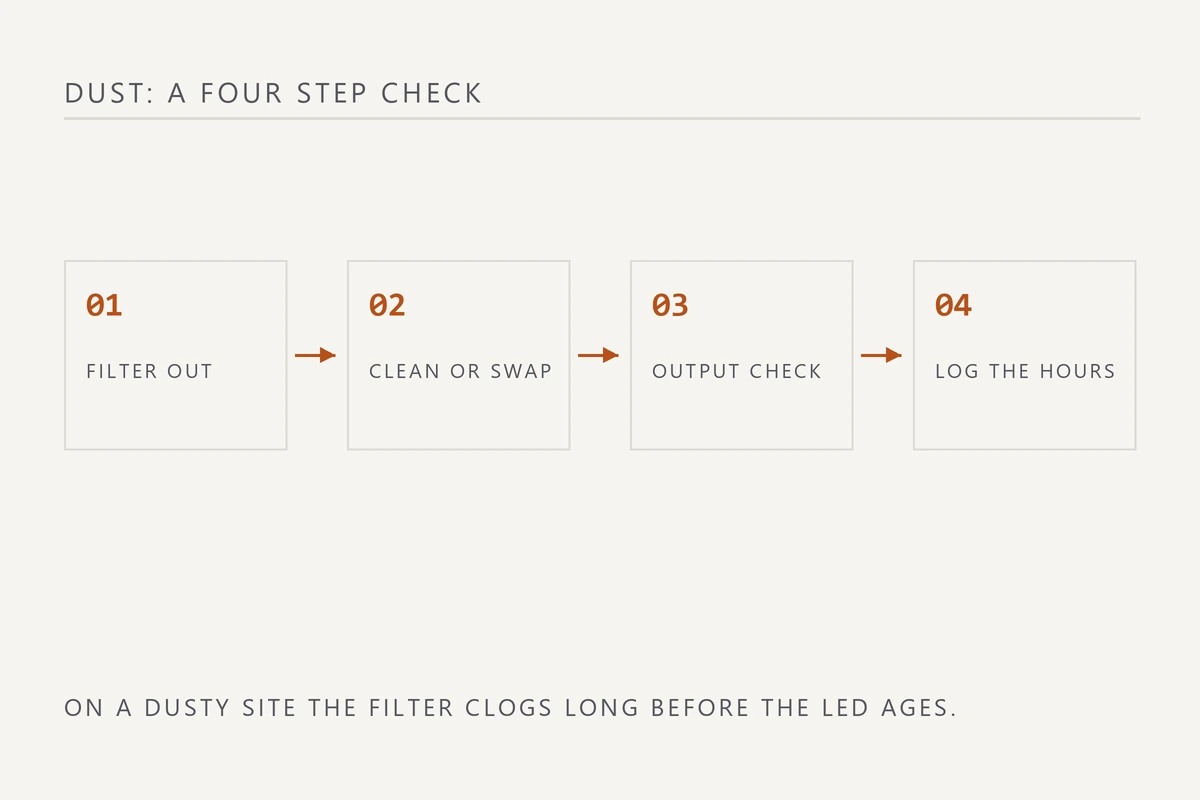
- Filter: take it out, hold it up to the light, replace it if it does not pass.
- Diffuser: check tension, marks and old repairs before the balloon is inflated.
- Output: compare the head against a second unit on the same setting.
- Hours: log the running hours and the site, so the next interval follows duty.
The output comparison is the step crews skip, and it is the one that catches the problem early. A head that is ten percent down is hard to see on its own and obvious beside a second unit. By the time the loss is obvious without a reference, the filter has usually been in place for months.
Storage is part of maintenance
A balloon packed wet grows a smell and a stain. A diffuser folded along the same crease every night fails along that crease. The head should go into its bag dry, with the filter clean or removed, and the balloon should be folded loosely rather than pressed flat under the mast.
| Part | What fails | What to do |
|---|---|---|
| Insect and dust filter | Loads with fines, cuts airflow | Clean, then replace when flow does not return |
| Diffuser | Sags, stains, creases, patches | Keep taut, dry and loosely folded |
| Balloon seam | Separates at a fold line | Check before inflation, not after |
| Housing seal | Dust past a tired gasket | Wipe the seat, replace when it no longer closes |
| Telescopic mast | Grit in the sections | Wipe and dry before collapsing |
The LED is rated for a long life on the sheet. The filter, the diffuser and the mast decide whether the head is still at that output when the rating has any meaning, and all three are service items rather than warranty arguments.
Updated 2026-10-24 · 4 min read. Specifications change without notice; confirm the current sheet before you publish a claim or write a tender document.
Questions that come back
Short answers, before the email.
How often should the filter be changed?
By duty, not by calendar. A head that runs ten hours a night in a quarry loads a filter far faster than one that runs two hours on a paved street, so log the hours and the site and set the interval from the second cleaning.
Can the diffuser be washed?
It is a flame retardant fabric and it can be wiped, but it should not be soaked, scrubbed or packed wet. A stained diffuser that is still taut is better than a clean one that has been stretched.
Does IP54 mean the head can be hosed down?
No. IP54 is dust protected and splash resistant. The floodlight heads carry IP66 and a different instruction, so the two should not be cleaned the same way.
Why does the head look dimmer than the new one?
Usually the filter, then the diffuser. Compare it against a second head on the same setting before assuming the LED has aged.
Can a balloon light be used in rain?
Splash is covered and rain is not the same as a jet. A head on a mast in open rain should come down, and the balloon should be dried before it is packed.
Send the site, get the configuration.
Head, mount, power and the specification sheet for each line item, in one reply.