Mobile light tower: battery or generator on one cart
The lamp, the mast and the power source on a wheeled cart, so one person moves the whole lighting setup between work zones. Three cart sizes take the range from 60 W to 1400 W, and the power choice is the decision that matters.
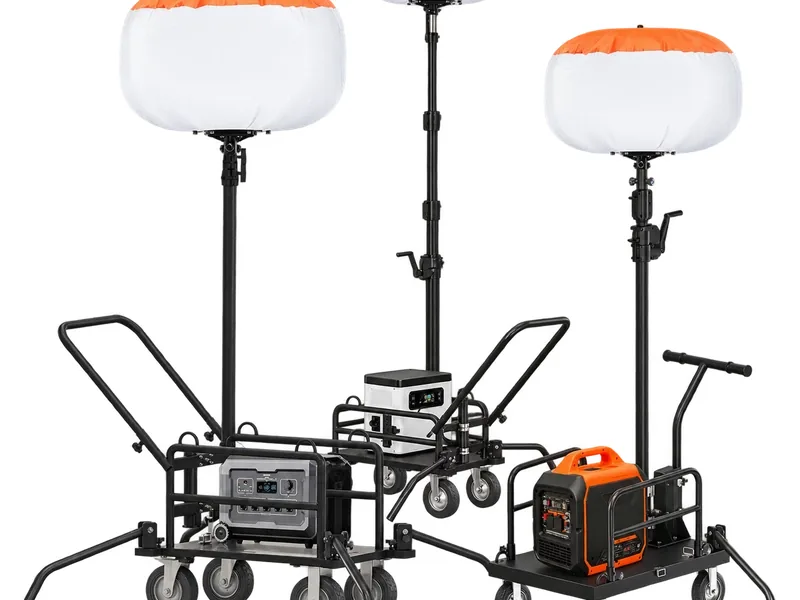
Three cart sizes take the range from 60 to 1400 W. The power source sits on the cart, so the unit is one object to move rather than three to carry.
Builds in this line (2)
Battery or generator
The same cart and the same lamp, two ways to power it. The site decides, not the catalogue.
Cart sizes
Cart size follows the lamp, because the mast and the counterweight follow the lamp.
| Cart | Lamp range | Max height | Cart weight | Mobility |
|---|---|---|---|---|
| Small | 60-320 W | 2.4 m | 16 kg | Folding platform, braked wheels |
| Medium | 320-600 W | 3.4 m | 28.5 kg | Basket frame, braked wheels and stabilisers |
| Large | 700-1400 W | 4.1 m | 48 kg | Open platform, braked wheels and stabilisers |
Height is the deployed mast with the lamp mounted. The large cart stands 2.0 x 1.7 m on the ground with the stabilisers down, so it needs a footprint, not just a parking space.
What a mobile tower is for
A tripod is faster to place and cheaper. A mobile tower wins when the light has to follow the work: a paving train that moves a hundred metres an hour, a maintenance crew working along a tunnel, an emergency scene where the command post moves twice in a night. The cart carries the lamp, the mast and the power, so relocation is one person and one trip.
Brakes and stabilisers are not detail. A 4.1 m mast with a 12.8 kg head on top has a high centre of gravity, and a cart that rolls while the mast is up is the most common way these units get destroyed.
- Carts
- Small, medium, large, plus custom frames
- Lamps
- 60 to 1400 W, the same heads as the tripod line
- Power
- Power station or petrol generator, matched to the lamp
- Mast
- Telescopic, 2.4 to 4.1 m depending on cart
- Mobility
- Braked wheels, stabiliser legs on the larger carts
- Balloon
- Replaceable filter, flame retardant fabric
- Protection
- IP54 on the lamp
- Warranty
- 5 years on the lamp
Sizing the power to the lamp
The arithmetic that decides between a battery and a generator.
- Match the continuous rating, not the peak. A 1000 W lamp needs a supply that holds 1000 W continuous, and a 1000 W inverter that peaks at 2000 W is not that supply for eight hours.
- Add the conversion loss: plan on roughly ten percent on top of the lamp rating for the inverter and the charger.
- Count the hours: a 2,000 Wh station runs a 320 W lamp for about six hours with losses. The same station on a 1000 W lamp is under two hours.
- Plan the recharge: a battery tower is only as good as the charging window between shifts. A generator tower refuels in minutes.
Runtime figures on a quotation should name the lamp, the starting charge and the ambient temperature. A number without those three is a brochure figure.
Before the order
Three questions that change the configuration more than the wattage does.
- Shift length: eight hours on one charge, or refuel mid shift. It decides battery capacity or fuel tank, and it is the first question to answer.
- Surface: gravel, sand and slope all move the cart. Ask for the wheel type and the stabiliser footprint for the ground on site.
- Noise and fumes: a generator rules out a hospital car park, a residential street at night and an indoor job. A battery rules out a site with no charging point.
- Carts
- Small, medium, large
- Lamps
- 60 to 1400 W
- Power
- Power station or generator
- Ask for
- Shift length, ground, noise limits
Send the site, the hours and the power.
Site type, the hours the light has to run and what power is available is enough. The reply is a build, a specification sheet and the option list for each line item.