Balloon light for film: a room lit from the inside
A film set does not want a lamp, it wants a piece of sky in the room. That is what a balloon light is: a fabric sphere that becomes the source, so the light arrives from a surface the size of a person instead of from a point the size of a fist.
Softness is source size, not wattage
Soft light is light that arrives from many directions at once. A large source close to the subject wraps around it. Shadows open, skin holds its texture without a hard edge, and the falloff is gradual because the source covers a wide angle. A small source at the same output sends the same amount of light from one direction, which is hard light with a crisp shadow and a fast falloff.
A balloon head gets this from geometry. The fabric diffuser is the source and the distribution is 360 degrees, so the balloon can work as a practical in frame as well as a source out of it: a paper lantern on a set, a glowing column in a corridor, a soft key above a table.
The balloon grows with the head
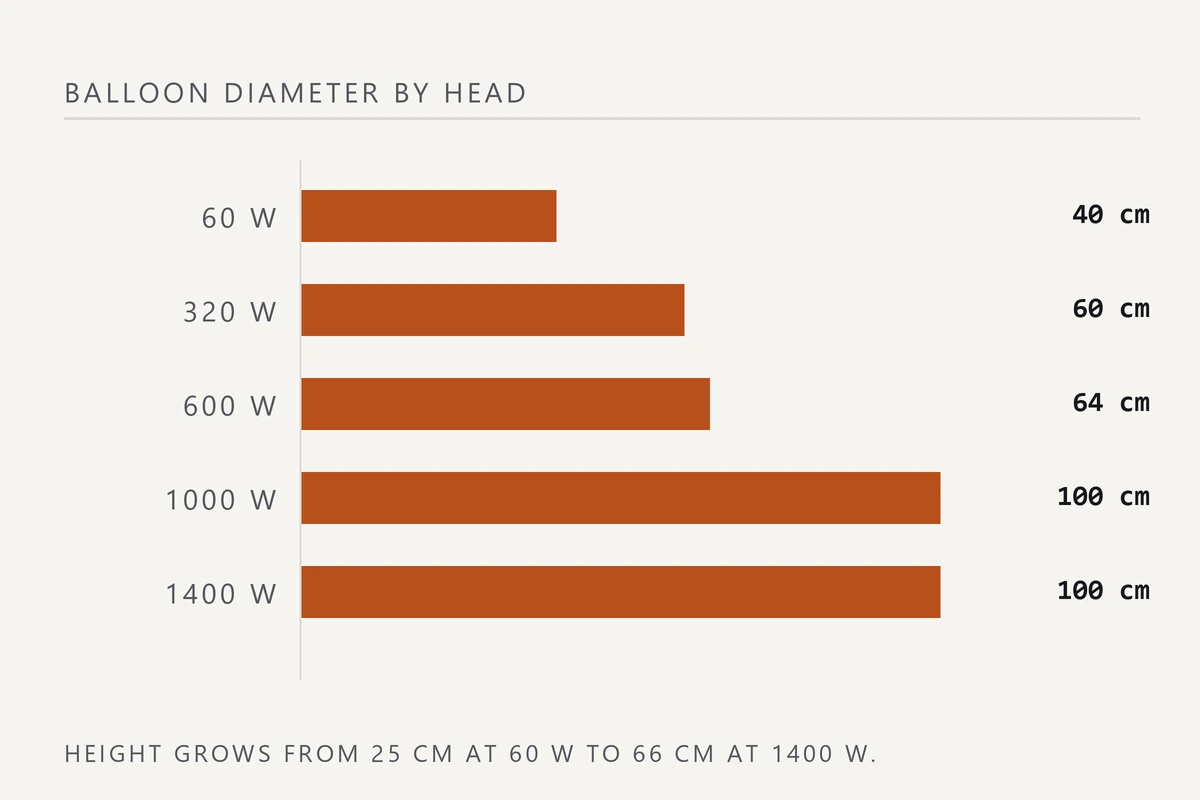
The inflated balloon is the first number a gaffer asks for, because it sets the quality of the light and the space the unit needs. On the line the balloon runs from 40 cm on the 60 W head to 100 cm on the 1000 W and 1400 W heads, while output moves from 9,600 lm to 224,000 lm over the same span.
Height grows with it, from 25 cm at 60 W to 66 cm at 1400 W. That is the number that decides whether a unit fits under a low ceiling, inside a set piece, or in the back of a car with the seats down.
Colour on set
The RGBW units carry RGB plus a 3000 K white channel on a 100 cm or 130 cm balloon, at 14,000 lm and 28,000 lm. That covers two jobs in one unit: a warm white key, and a coloured practical when the frame needs a colour instead of a white. Control is a 2.4 GHz RF remote plus a button on the housing, and dimming is supported.
The white channel is the part that decides whether the unit can carry a face. 3000 K sits well beside tungsten practicals and reads as evening light. The tripod heads are the other half of the same choice: they are rated at 5000 K, which is a cooler white for a night exterior or a work light that has to look neutral on camera.
What the sheet does not say
Two numbers a film buyer asks for are not on the balloon range sheet. The first is colour rendering. The floodlight heads state CRI 70 or better and the balloon heads do not state a figure at all. The second is flicker behaviour at low dim levels, which matters as soon as a camera runs at a high frame rate or a short shutter.
Neither gap is a reason to walk away. Both are reasons to ask, and a supplier who answers with a measurement has answered the question. One who answers with an adjective has not, and the answer will not survive the first playback on a big screen.
Rigging and power on location
The tripod heads run on AC 100 to 277 V, which covers a European set and a North American one without a transformer on the truck. The masts run from 2.0 m to 4.8 m with load ratings from 20 kg to 80 kg, and the smaller sizes are set up by one person, which is the difference between a two minute reposition and a two person job. The tripod range carries the height and load for each size.
IP54 on the head means a light stand on a wet exterior is not an emergency. It does not mean the balloon should stay up in a storm, and it does not cover a diffuser that is packed away wet.
Before the shoot
- Balloon size against the space: 40 cm for a corner or a set piece, 100 cm for a room.
- White channel temperature, and whether colour is needed in the same unit.
- Control: remote, housing button, or a layer the board already runs.
- Colour rendering and flicker, asked as numbers rather than as adjectives.
| Head | Balloon | Output | Best for |
|---|---|---|---|
| 60 W | 40 cm | 9,600 lm | A corner, a car interior, a small set piece |
| 320 W | 60 cm | 51,200 lm | A room key or a soft fill |
| 1000 W | 100 cm | 165,000 lm | A large room or a night exterior |
| 1400 W | 100 cm | 224,000 lm | A street, a yard, a big build |
| 100 W RGBW | 100 cm | 14,000 lm | A warm white key with colour in one unit |
| 200 W RGBW | 130 cm | 28,000 lm | A larger set that needs colour |
None of these figures is a lighting design. They are the numbers the sheet states, and the design is what a gaffer does with them on the day.
Updated 2026-10-24 · 4 min read. Specifications change without notice; confirm the current sheet before you publish a claim or write a tender document.
Questions that come back
Short answers, before the email.
Is a balloon light soft enough to key a face?
Yes, when the balloon is large relative to the subject and close enough to wrap. A 100 cm balloon at two metres is a soft key. The same balloon across a street is a bright point again.
Can a balloon light be used in frame?
That is one of the reasons to use it. The fabric sphere reads as a practical, so the same unit can light the scene and appear in it, which is harder to do with a panel and a frame.
What colour temperature are the balloon heads?
The tripod heads are rated at 5000 K. The RGBW units carry RGB plus a 3000 K white channel, so a warm white and a colour are available from the same balloon.
What is the colour rendering?
The balloon range sheet does not state a CRI figure. The floodlight heads state CRI 70 or better. Ask for the measurement on the specific head rather than assuming the range figure applies.
How much power does a 1000 W head need?
It runs on AC 100 to 277 V, so the supply is a circuit question rather than a voltage question. A 1000 W head on a 230 V circuit draws about 4.3 A at full output, and the circuit has to be rated for the whole load on it.
Send the site, get the configuration.
Head, mount, power and the specification sheet for each line item, in one reply.