Work zone lighting: a lane closure lit from one mast
A lane closure is the most constrained lighting job on a road. There is a work face at ground level, traffic passing a few metres away, and a window at each end of the shift for setting up and taking down. The light has to serve the work without joining the traffic.
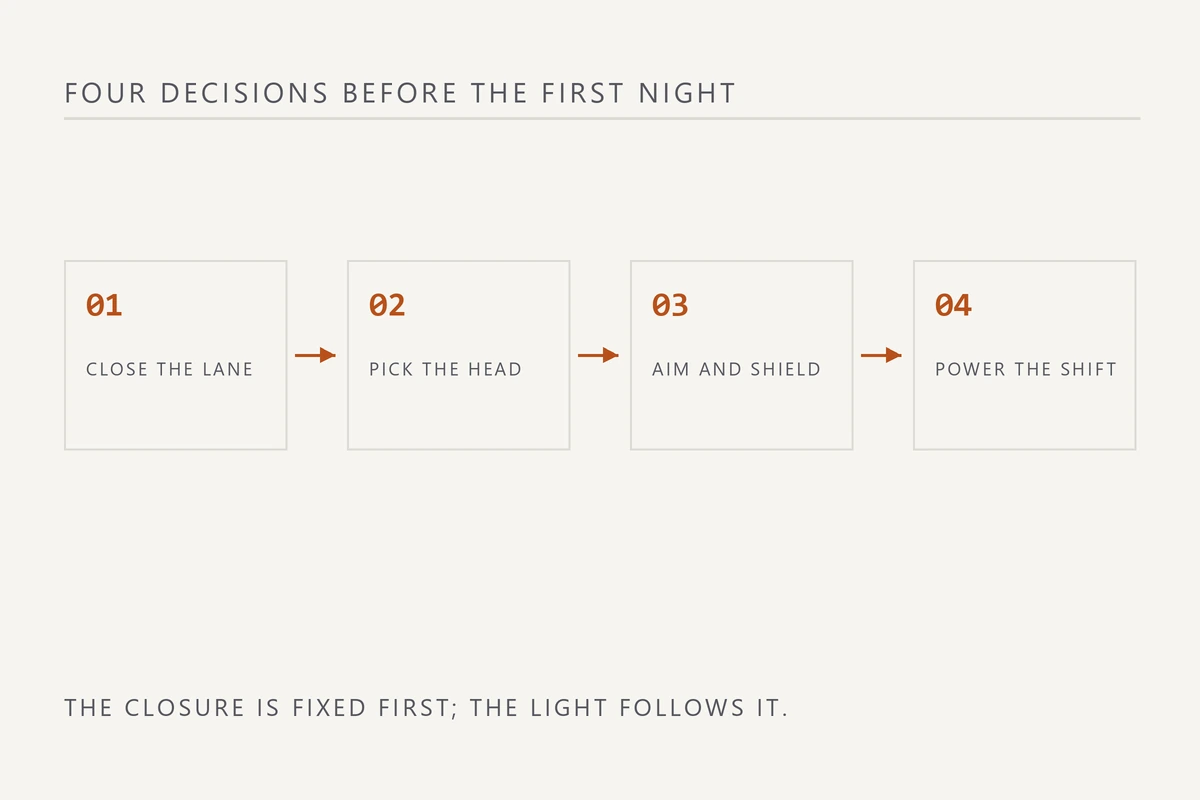
The closure decides the layout
Start with the shape of the closed area, not with the lamp. A single lane closure on a straight carriageway gives a long, narrow work face and a short taper, and the light belongs over the work face rather than over the taper. A closure that shifts traffic onto the other side is a different plan, because the driver's eye has to stay on the lane line and off the source.
Three measurements settle the layout before anything is ordered: the length of the work face, the distance from the nearest live lane, and the direction traffic approaches from. Those three pick the mounting height and the side the light stands on, and none of them appears on a product sheet.
A diffused source over a work face
A balloon head is a diffused source, and that is what a closed lane wants: light leaves a surface rather than a point, so the work face is lit evenly and a person walking through the pool does not throw a hard shadow across the joint being worked on. The penalty is that a diffused head has no cut off. It lights in every direction, including towards the traffic.
An aimed floodlight does the opposite. A symmetric or an asymmetric head puts light where it is pointed and very little behind it, which is what a long throw or a sign face needs, and it is a harsher source to work under for a whole shift.
The two together are often the right answer: a balloon over the work face for the shift, and a floodlight aimed at the merge or the sign, screened from the approach. That split also keeps the bright source out of the mirror of a car going past at speed.
The glare line, not the lumen count
Glare is decided by the angle between the source and the driver's eye, not by how many lumens the head makes. A diffused head at 2.8 m sits close to the eye height of a car occupant and stays visible from a long way back on a straight road. Raise it, move it back so the screen or the plant blocks the line, or put the source on the far side of the work face.
On a curve the line changes with the approach, so the place that works for one direction of travel is wrong for the other. A closure that stays up for a week wants the source positioned for the busiest approach, and one that moves every night wants a layout that a crew can repeat in the dark.
Power for the shift
A battery cart carries a head from 60 to 600 W on a pack of 1,000 to 2,000 Wh, up to 96,000 lm at the top of that range, with no noise and no exhaust at the work face. As a working figure, a 2,000 Wh pack runs a 320 W head for about six hours after the inverter's share, which is a short shift rather than a long one.
Above 600 W on the lamp the job belongs on a generator cart, 2.2 kW on the set and 224,000 lm at the top of the range, in exchange for a refuel and an exhaust. The runtime question is the one to settle before the head, because a closure lit for six hours is a different purchase from one lit all night.
Deploy and withdraw
The closure is lit at the start of the shift and dark at the end of it, so the kit is handled twice a night. Cart weights run from 16 kg to 48 kg, a cart mast goes to 4.1 m and a tripod to 4.8 m, and the balloon packs to a bag rather than a crate. One person with a cart does the job in two trips and a two person crew does it in one, which is the number that matters when the window is twenty minutes.
Wind is the other half of deployment. An inflated balloon on a mast is a sail, and the wind rating belongs in the quotation with the ballast for the same head on the same support, on one sheet rather than in two emails.
What the traffic plan asks you to state
| Question | The number to bring |
|---|---|
| Length and position of the work face | Metres, with a sketch |
| Distance to the nearest live lane | Metres, measured on the ground |
| Mounting height | Metres from the surface to the head |
| Glare control | What screens the source from the approach |
| Power and runtime | Watt hours against the hours of the shift |
| Setup and withdrawal | Minutes, and how many people |
A work zone light is judged by the driver who passes it, not by the crew under it. If the source is visible from the approach for the whole length of the taper, the best head on the market is the wrong installation.
Updated 2026-10-26 · 4 min read. Specifications change without notice; confirm the current sheet before you publish a claim or write a tender document.
Questions that come back
Short answers, before the email.
How high should a work zone light be?
High enough that the source sits above the driver's eye line and is screened from the approach. A 2.8 m tripod puts a diffused head close to eye height, so a taller mast or a different position is often the cheaper fix.
Is a balloon light suitable for a lane closure?
For the work face, yes. The diffused source lights evenly and throws no hard shadows. It has no cut off, so it has to be positioned and screened for the traffic.
Battery or generator for a night closure?
A battery cart covers 60 to 600 W and about six hours on 2,000 Wh, which suits a short shift. Above that, or for a night that outlasts a pack, a generator cart takes the range to 1400 W.
Can one person set up a work zone light?
A tripod head, yes. A cart is 16 to 48 kg depending on size, and a 4.1 m mast in wind is a two person lift.
What about rain and dust on a closure?
Balloon heads are IP54, dust protected and splash resistant, and the floodlight heads are IP66. A head on a mast in open rain comes down, and the balloon is dried before it is packed.
Send the site, get the configuration.
Head, mount, power and the specification sheet for each line item, in one reply.