Mobile light tower cart: what the size decides
The cart is the part of a mobile light tower that decides how the unit moves, and it is chosen after the lamp rather than before it. Three sizes cover the range, and the step between them is a lift, a footprint and a mast.
The lamp picks the cart
The three carts are matched to lamp bands rather than to budgets. The small cart carries 60 to 320 W, the medium 320 to 600 W and the large 700 to 1400 W, with the mast following the lamp at 2.4 m, 3.4 m and 4.1 m deployed. That order is not arbitrary: the mast and the counterweight are sized by the head that goes on top of them.
The heads are the same ones the tripod line uses, from a 60 W head at 9,600 lm on a 40 by 25 cm balloon to a 1000 W head at 165,000 lm and a 1400 W head at 224,000 lm on a 100 cm balloon. A cart changes how a head moves, not what it does, so the light level is decided first and the cart is the logistics answer to it.
Power comes with the cart rather than instead of it. A cart runs a battery station or a petrol generator, and the choice between them is made by the shift length and by whether the site has a window to recharge, not by the size of the cart.
Weight at the three sizes
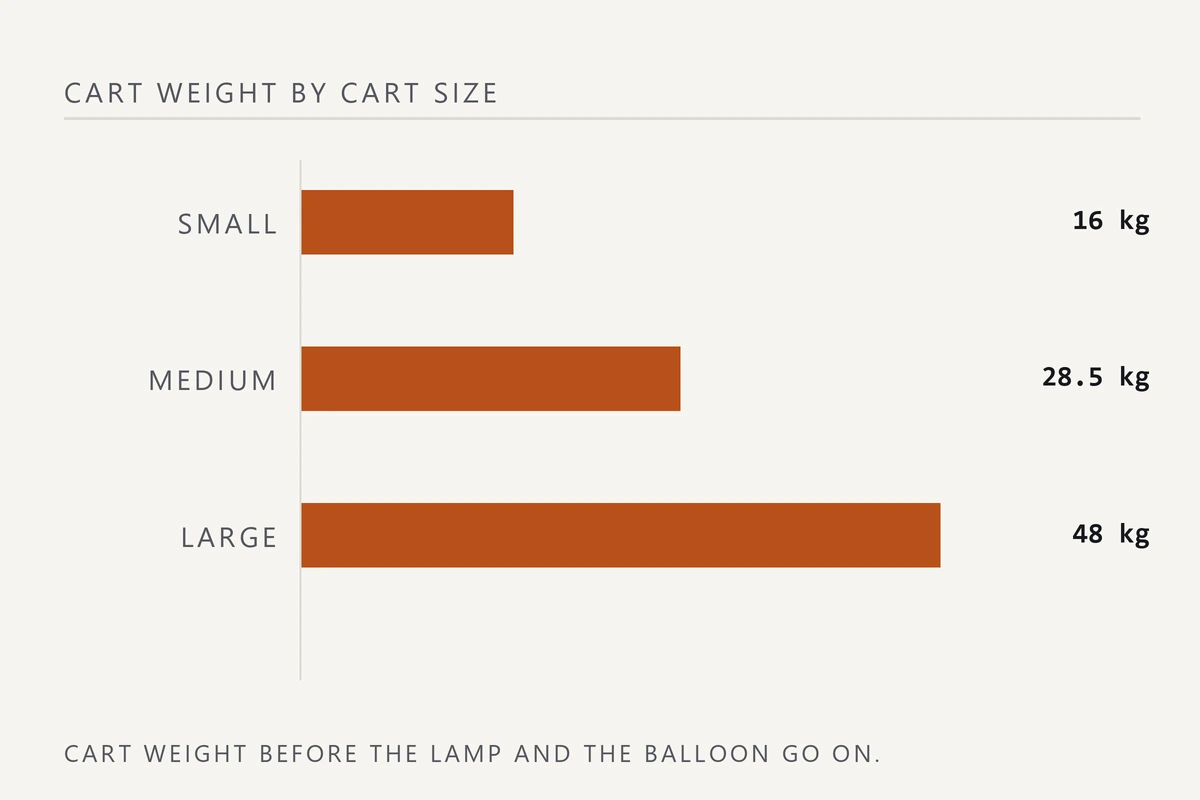
16 kg, 28.5 kg and 48 kg are the cart weights, before the lamp and the balloon go on. The first is a lift one person can make into a van. The second is a lift for two people, or a ramp. The third is a ramp and a second pair of hands, and the step between the last two is the one that surprises buyers who have only seen photographs.
Add the head and the gap widens, because the largest cart is also the one that takes the 12.8 kg head. A unit that reads as 48 kg on a page is a different object on a tail lift in the rain, and that is the moment the size decision is tested.
The footprint with the legs down
The large cart stands 2.0 by 1.7 m on the ground with its stabilisers down. That is a footprint rather than a parking space, and it is the number that decides whether the unit can work in a closed lane, between two rows of racks, or on a footpath beside a trench.
The medium and the large cart both carry braked wheels and stabiliser legs, and the small cart is a folding platform with brakes. That equipment is not detail. A 4.1 m mast with a 12.8 kg head on top has a high centre of gravity, and a cart that rolls while the mast is up is the most common way one of these units is destroyed.
Ground, wheels and the footing
Gravel, sand and a slope all move a cart. The question worth asking is not whether the wheels brake but what the unit stands on once the legs are down, because a stabiliser on gravel is a different footing from a stabiliser on asphalt, and a slope turns a level footprint into a job for a spirit level and a second person.
Ask for the wheel type and for the stabiliser footprint for the ground on site. It is a two line answer from a supplier and a two day recovery on the site when it is wrong.
What the cart buys over a tripod
A tripod is faster to place and lighter to carry, and the tripod range covers five heights for exactly that reason. A cart wins when the light has to follow the work: a paving train that moves a hundred metres an hour, a maintenance gang working along a tunnel, or a scene where the command post moves twice in a night. The cart carries the lamp, the mast and the power, so relocation is one person and one trip rather than three people and a vehicle.
That advantage disappears when the cart cannot reach the work. A large cart with its legs down needs the footprint above, and a gate, a doorway or a lift shaft has a width of its own that no specification sheet mentions.
The three carts, side by side
| Cart | Lamp range | Mast | Weight | Mobility | Suits |
|---|---|---|---|---|---|
| Small | 60-320 W | 2.4 m | 16 kg | Folding platform, braked wheels | A van, a footpath, one person |
| Medium | 320-600 W | 3.4 m | 28.5 kg | Basket frame, braked wheels and stabilisers | A yard, a lane closure, two people |
| Large | 700-1400 W | 4.1 m | 48 kg | Open platform, braked wheels and stabilisers | A wide site, a rail job, a ramp |
Read across the lamp range and the choice is made for you by the head. Read across the last column and it is made again by the route and the ground. Where the two disagree, the smaller cart with the smaller head is the answer that reaches the work, and a tower that reaches the work beats one that does not.
What to send with the enquiry
- The lamp in watts, and the area it has to light.
- The shift length, because it decides the power source before it decides the cart.
- The route: a gate width, a lift, a ramp or a tail lift.
- The ground, because gravel and asphalt are two different footings.
- The number of people who will move the unit, on most nights rather than on the first one.
The cart is chosen after the lamp and before the route. Get the order wrong and the light still works, and nobody can move it.
Updated 2026-10-30 · 4 min read. Specifications change without notice; confirm the current sheet before you publish a claim or write a tender document.
Questions that come back
Short answers, before the email.
How heavy is a mobile light tower cart?
16 kg for the small cart, 28.5 kg for the medium and 48 kg for the large, before the lamp and the balloon are added. The large cart is also the one that takes the heaviest head.
What mast height does each cart give?
2.4 m on the small cart, 3.4 m on the medium and 4.1 m on the large, with the lamp mounted and the mast deployed.
Can one person move the large cart?
On level ground with the wheels braked and the legs down, yes. Lifting it into a van is a two person job or a ramp, and the 48 kg figure is the reason.
Do the carts take the same lamps as the tripod line?
Yes. The same heads run from 60 W to 1400 W, so a fleet can move a lamp between a tripod, a cart and a spare mast.
What ground does a mobile tower need?
Firm and level, with the stabilisers down and the wheels braked. Gravel and sand need a wider footing, and a slope needs a second person and a level check before the lamp goes up.
Send the site, get the configuration.
Head, mount, power and the specification sheet for each line item, in one reply.