How to measure light level on site: proof, not a promise
A light tower is bought on a coverage figure and accepted on a meter reading, and the two are rarely the same number. The gap is not dishonesty. It is the difference between a rated area and one particular site on one particular night.
Why the sheet and the site disagree
The rated figure assumes a clean diffuser, a head at the recommended height and a working level across the whole area. A site adds what the sheet cannot know about: dust on the fabric, a wall that takes light away, wet ground that throws it back at a different angle, and an edge where the level falls off faster than the middle suggests.
A measurement is the only way to find out which of those is happening, and it is cheap. A meter costs less than a second head, and one night with it settles an argument that otherwise runs until the invoice is paid.
Where the meter goes
Measure the work face, not the pool under the mast. The brightest point in the lit circle is the least useful number on the site, because nobody works directly under the head with their back to it.
Four to six points across the working area are enough: the corners, the middle, and the place where the crew actually stands. Add the walkway if people move through the lit area, and add the boundary line if there is a neighbour or a live lane on the other side of it.
Hold the sensor at the height the work happens at rather than always at the ground. A meter on the floor measures a walkway; a meter at the height of a form, a trench edge or a bench measures the task, and the two numbers can differ enough to change the head that gets ordered.
The four passes
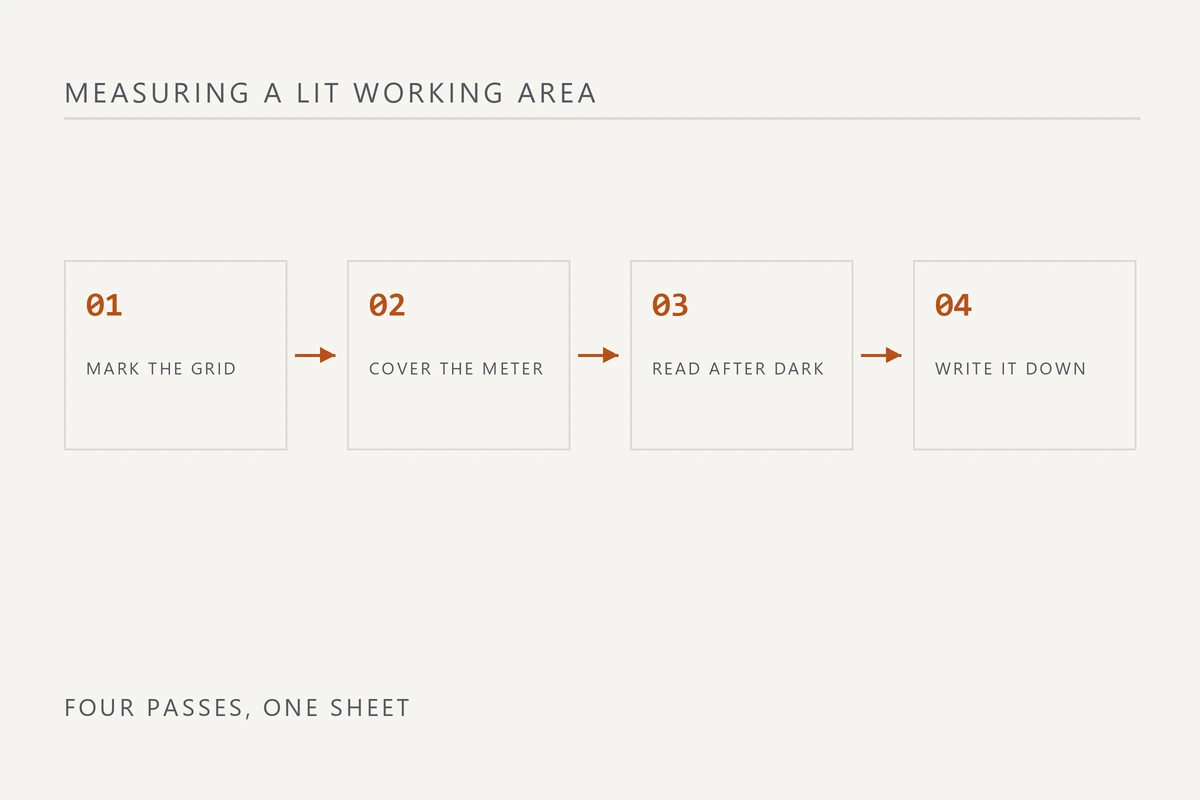
Mark the grid first, so the second visit measures the same points. Cover the sensor from the head and from the sky: a meter read in the open under a bright source collects stray light and reports a level the ground does not have.
Read after dark with the final lamp configuration. A reading taken at dusk, or with one head of two running, is a reading of a different installation, and the number will not survive the first night of real work.
What goes on the sheet
| Field | Why it has to be there |
|---|---|
| Time and date | The level moves with the lamp and with the state of the diffuser |
| Head and wattage | A number without the head beside it cannot be compared with another site |
| Mast height | The same head at 2.8 m and at 4.8 m is a different installation |
| Points and readings | One average hides the shadow the crew complains about |
| Weather and surface | Wet ground, mist and dust all move the reading |
| Hours on the lamp | A diffuser that has run for a month is not the one first measured |
When the number is short
Fix the cheap things first. A dusted diffuser and a filter that has not been cleaned cost output every shift, and cleaning is a ten minute job with a ladder. Then check the height and the aim, because a head that was lowered for a gust and never raised again is the commonest reason a site is short of light in its second week.
After that the answers cost money: reduce the area, add a second head, or accept a lower level on the walkway and keep the work face bright. What does not work is buying a larger head before the cheap causes are excluded, which is how a site ends up with a 1400 W unit and the same complaint.
Check the supply before the lamp as well. A head running from a battery that is nearly flat dims as the voltage falls, and a generator that is close to its rating sags on a heavy load. Both show up as a reading that is short at the end of a shift and normal at the start, which is a power problem wearing a lighting problem's clothes.
Keep the record
A photograph of the meter in front of the tower, with the date and the reading visible, ends most conversations about whether the light was adequate. Keep it with the shift paperwork, and take a second set of readings when a complaint arrives rather than after the unit has been packed away.
The record is also how a fleet learns. Three sites with the same head, the same height and the same complaint is a pattern, and a pattern is a specification problem rather than three bad sites.
A meter reads what is in front of it, not what the crew sees. Take the readings where the task happens, at the height the task happens, and write down what the lamp was doing at the time.
Updated 2026-10-27 · 4 min read. Specifications change without notice; confirm the current sheet before you publish a claim or write a tender document.
Questions that come back
Short answers, before the email.
What lux level should a site have?
It follows the task rather than the site. A yard works at roughly 50 lux, and a trench or a pit where a fitter has to see a joint can want 200. Ask for the level the task needs before the wattage.
Can I measure light with a phone app?
An app is a rough check and a meter is a record. Use the app to find the dark corner, then measure that corner with a meter if the number has to be defended later.
How many readings are enough?
Four to six across the work face, plus the walkway, plus the boundary if there is one. A single reading proves nothing except that the meter works.
Why is the level lower in the second week?
Dust on the diffuser, a mast that was lowered and not raised again, or a head that was dimmed to stretch a battery. All three are visible in ten minutes and none of them needs a new lamp.
Should I measure at night or at dusk?
After dark, with every head that will run that night switched on. Dusk readings flatter an installation and cannot be compared with a night reading taken later.
Send the site, get the configuration.
Head, mount, power and the specification sheet for each line item, in one reply.