Light tower wind rating: what actually holds a mast up
A tripod sheet gives a load rating in kilograms, and that figure answers a different question from the one a site asks on a windy night. Wind does not arrive as a weight. It arrives as a push at the top of a lever, and the lever is the mast.
The kilogram figure is not a wind figure
A load rating is the static mass a support holds at full extension with a head mounted. It covers the head, the balloon and the hardware at the top, and it leaves a margin that movement spends rather than weight. A 12.8 kg head on a mast rated at 40 kg is not a 27 kg allowance for wind, because the wind does not push down.
What the wind does is bend the mast and rotate the base. A 100 cm balloon at the top of a 4.8 m mast is a sail on a lever, and the force up there is multiplied by the distance to the ground. That is why two supports built from the same tube can carry different ratings, and why the load figure on its own does not tell a buyer whether the tower will stand.
The mast is a lever, and height is the multiplier
The tripod range shows the effect without any theory. The 2.0 m and 2.8 m tripods are rated at 20 kg, the 3.8 m and 4.0 m tripods at 80 kg, and the 4.8 m mast at 40 kg. Nothing about the tube got weaker at the top of the range. The same head sits further from the ground, so the same push produces a larger moment at the legs.
That is the number to read before the brochure number. A crew that wants the head above the plant, the hoarding and the parked plant is asking the mast for height, and every metre of it costs stability that has to be paid back in ballast, in a wider base or in a shorter mast.
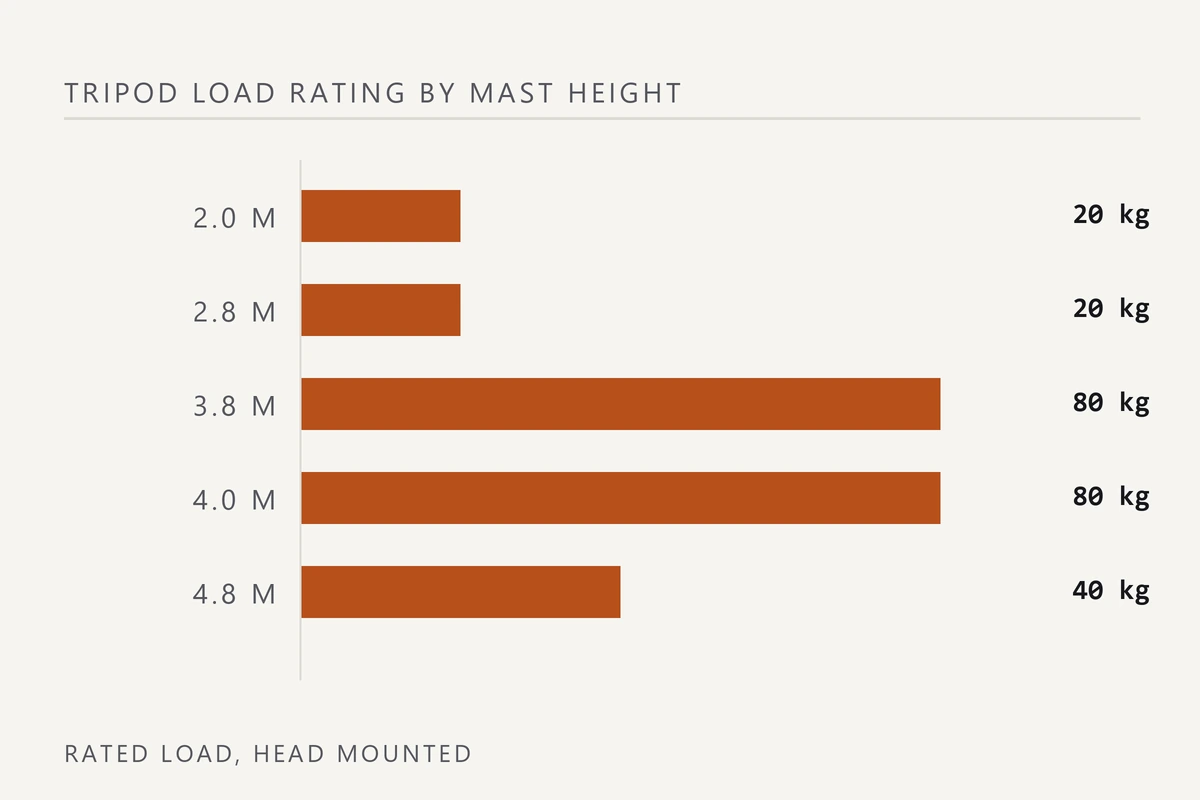
What each support is rated for
| Height | Rated load | What it carries |
|---|---|---|
| 2.0 m | 20 kg | A floodlight pair or a small balloon head |
| 2.8 m | 20 kg | A 500 W class head |
| 3.8 m | 80 kg | The heavy heads, including 1000 and 1400 W |
| 4.0 m | 80 kg | The heavy heads, with more height |
| 4.8 m | 40 kg | The largest balloon heads, on the tallest mast |
The head weights run from 1.9 kg on the 60 W head to 12.8 kg on the 1400 W one, so every head in the range is a small share of the 40 kg rating at 4.8 m. The rating is not there for the lamp. It is there for the lamp plus everything the weather adds, and a longer lever spends that allowance faster than a short one does.
Ground, ballast and the surfaces that catch buyers out
A tripod needs a surface that holds a foot without creeping. Compacted hardstanding and concrete are the easy cases. Soft sand, fresh asphalt and a cambered verge are the three that catch buyers out, because a leg sinks or slides and the mast leans before the wind has done anything at all.
Ballast belongs on the legs or on the frame, low and spread, and never hung on the mast. A cart answers the same question differently: the small, medium and large carts weigh 16, 28.5 and 48 kg with braked wheels and stabilisers, so the mass that holds the tower down is also the mass that has to be pushed into position.
What to ask for, in writing
- The wind speed the support is rated to with that head mounted at full extension, and whether the figure changes with the balloon size.
- The ballast or the anchors the supplier expects for the surface on the site, in kilograms.
- The mast section the rating applies to, because a figure for a half raised mast is not the figure a crew will use.
- The gust at which the balloon comes down, and who on site is watching for it.
- The difference between IP54 and windproof, which are unrelated properties and often quoted in the same sentence.
The sequence that keeps it standing
Inflate at ground level, raise the mast last, and lower it first. A balloon inflated with the mast already up is a sail being raised in the worst possible order, and a unit that goes up in two minutes in calm air takes two people and a ladder in a gust.
Take it down at the end of the shift rather than leaving it standing overnight. A tower left up is a tower that meets the weather nobody scheduled, and a balloon left out in high wind is a damaged fixture whatever the IP number says. The same rule covers the extras: a banner, a sign or a cable tied to the mast adds sail area that the rating never included.
A wind rating is only useful with the head, the height and the ballast beside it. Ask for the four as one figure, and treat a supplier who quotes a wind speed without asking which head is mounted as a supplier who has not read the sheet.
Updated 2026-10-27 · 4 min read. Specifications change without notice; confirm the current sheet before you publish a claim or write a tender document.
Questions that come back
Short answers, before the email.
Will a light tower blow over?
Not if the support is rated for the head at the height used and the legs are ballasted for the surface. The failures tend to be an unballasted tripod, a mast at full extension under a 100 cm balloon, and a gust front that arrives before anyone has lowered it.
What does the kilogram rating on a tripod mean?
It is the static load the support holds at full extension with a head mounted. It covers the head and the hardware at the top, and the margin above the head weight is what the weather spends.
How much ballast does a tripod need?
Ask for the figure per support and per surface rather than a general rule. Sand, fresh asphalt and a slope all need more than concrete, and the number belongs in the quotation beside the wind rating.
Can a balloon light stay up overnight?
It can be left standing, and it should not be left inflated through weather nobody is watching. Lower the mast and deflate at the end of the shift, or hand the tower to someone who is on site for the night.
Does IP54 mean the tower is windproof?
No. IP54 covers dust and splashing water on the head. Wind is a structural question about the support, the height and the ballast, and the two numbers come from different tests.
Send the site, get the configuration.
Head, mount, power and the specification sheet for each line item, in one reply.