Light tower weight and transport: one van, one person
The number a site remembers is not the lumen figure. It is the weight of the thing two people have to lift over a kerb at the end of a shift, and whether it fits in a van that is already half full of barriers.
Three weights, not one
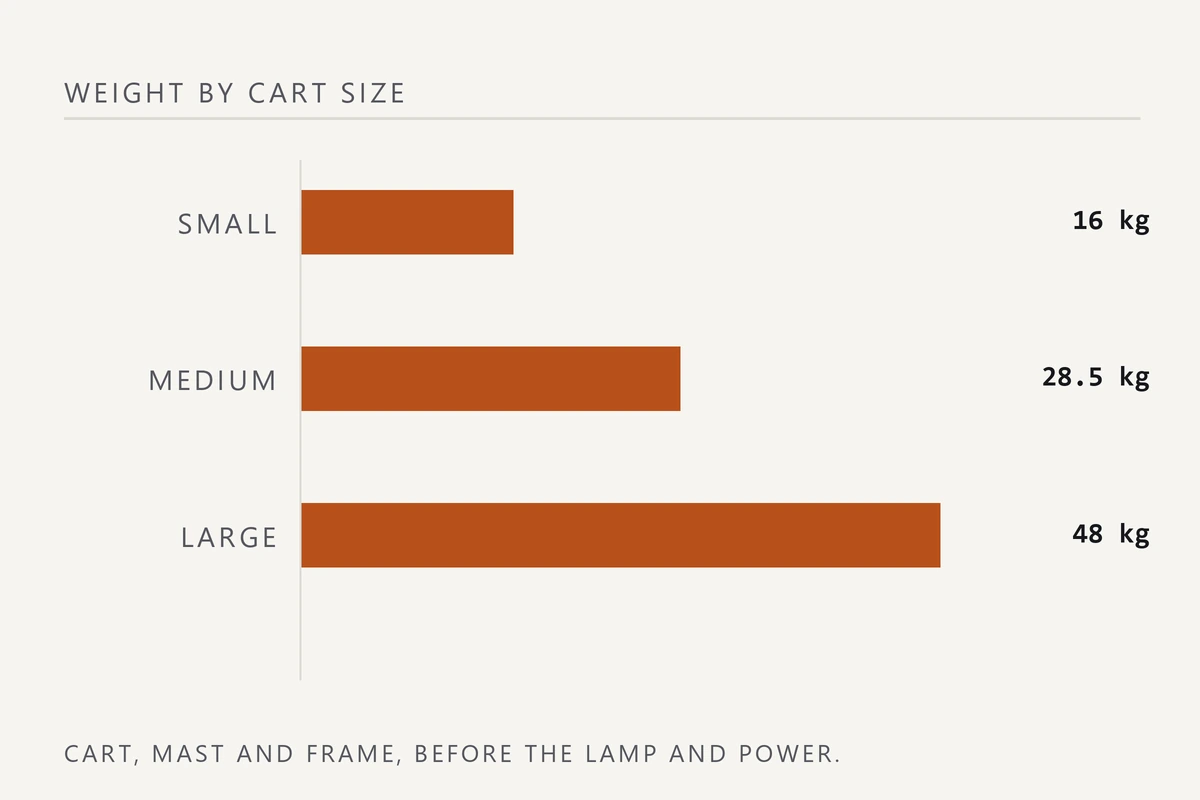
A tower is three loads. The head is the smallest: 1.9 kg at 60 W, 11.4 kg at 1000 W and 12.8 kg at 1400 W. The support is the awkward one, because a mast is long before it is heavy. The tripods run from 2.0 m to 4.8 m, the lightest is about 10 kg, and the load rating runs from 20 kg to 80 kg. The cart is the heavy one, at 16 kg for the small size, 28.5 kg for the medium and 48 kg for the large.
Those three numbers decide the job. A head one person carries, a mast two people raise and a cart that needs a ramp are three different days of work, and a quotation that quotes the head weight alone has answered the least useful part of the question.
The balloon is volume, not weight
The diffuser is fabric. An inflated balloon runs from 40 cm to 130 cm across, and packed it is a bag that sits on a shelf or in the boot of a car. That is also the reason a balloon is never carried inflated. The fabric and the ribs take a fold, and a balloon strapped down under tension at motorway speed is a warranty conversation rather than a transport plan.
What does take space is the mast. A 4.8 m tripod does not fold into a holdall, and two trips in a small van is normal for the largest size. A cart solves that by carrying its own mast, at the cost of the 48 kg and a footprint of about 2.0 by 1.7 m on the ground.
One person or two
- 60 to 320 W on a tripod: one person, no tools, head in a bag and the mast over a shoulder.
- 600 W: one person on a good day and two on a bad one, and the mast load rating is the number to check first.
- 1000 and 1400 W: two people for the mast, because the head is 11.4 kg or 12.8 kg on top of a 40 kg rated tripod.
- Cart mounted: one person moves it on braked wheels, two people load it into a vehicle.
What to measure before the order
| Measure | Where it comes from | Why it decides the order |
|---|---|---|
| Packed head length | The drawing, not the photo | Whether the bag fits the locker |
| Mast closed length | The tripod sheet | Whether it travels inside or on the roof |
| Cart footprint | The cart drawing | The space it needs on site and in the van |
| Wheel type | The cart specification | Gravel, sand and kerbs decide it |
| Head weight | The range table | Who lifts it, and how often |
Securing it on site, not only on the road
The transport question becomes a stability question the moment the mast goes up. A tripod needs a level patch or a ballast, and the two surfaces that catch buyers out are soft sand and fresh asphalt. The wind rating with the head mounted belongs in the quotation, because an inflated balloon is a sail and the figure is specific to that head on that support rather than to the range.
On a cart, brakes and stabiliser legs are the difference between a tower and a trolley that rolls while the mast is up. A 4.1 m mast with a 12.8 kg head on top has a high centre of gravity, and a cart that moves under it is the failure that ends a shift.
What to put in the vehicle spec
Four items belong in the first email: the internal height and length of the vehicle, whether there is a ramp or a lift, the surface the unit will cross at the venue, and how many people will be on site to move it. Those four pick the support and the cart before the head is chosen, and choosing the head first is how a 4.8 m mast ends up on a roof rack.
The 1400 W build is where this matters most: 12.8 kg of head, a 100 x 66 cm balloon and a 40 kg rated tripod. The generator cart takes the range to 1400 W with the power on board, which trades the 48 kg for a single object to move, and the battery cart stops at 600 W with a silent shift and no exhaust at the lamp.
Ask for the packed dimensions and the unit weight of the exact build, not of the line. A range that runs from 1.9 kg to 12.8 kg on the same page answers nothing about the unit in the quotation.
Updated 2026-10-25 · 4 min read. Specifications change without notice; confirm the current sheet before you publish a claim or write a tender document.
Questions that come back
Short answers, before the email.
How heavy is a 1000 W balloon head?
11.4 kg, on a 100 x 56 cm balloon. The tripod that carries it is a separate load and it is the longer of the two, which is what decides the vehicle.
Can one person set up a 1400 W tower?
The head is 12.8 kg, so it is liftable, but the 40 kg rated tripod and the 4.8 m mast are a two person job. Plan the number of people before the head is chosen.
Does the balloon need a large van?
No. The balloon is fabric and packs to a bag. The mast and the cart are what decide the vehicle, and two trips in a small van is normal for the largest mast.
How much ballast does a tripod need?
The wind rating with the head mounted is a quotation item rather than a published figure, and the ballast follows from it. Ask for both together, on the same sheet.
Can a light tower travel on a roof rack?
A folded tripod can, with the balloon inside the vehicle and the head boxed. A cart is a different answer: 48 kg on a roof is a two person lift and a strap question.
Send the site, get the configuration.
Head, mount, power and the specification sheet for each line item, in one reply.