Light tower coverage: how much ground one head lights
A light tower sheet quotes coverage in square metres, and the figure is only half a specification. The other half is the level at which the head still delivers it, and the level is a decision about the task rather than about the lamp.
What the coverage figure means
The number on the range sheet is the area a head is rated to light at a working level. It is not a promise about the ground: the same head covers a larger area at a low level and a smaller one at a high level, and the sheet has to pick a point on that line before it can print anything.
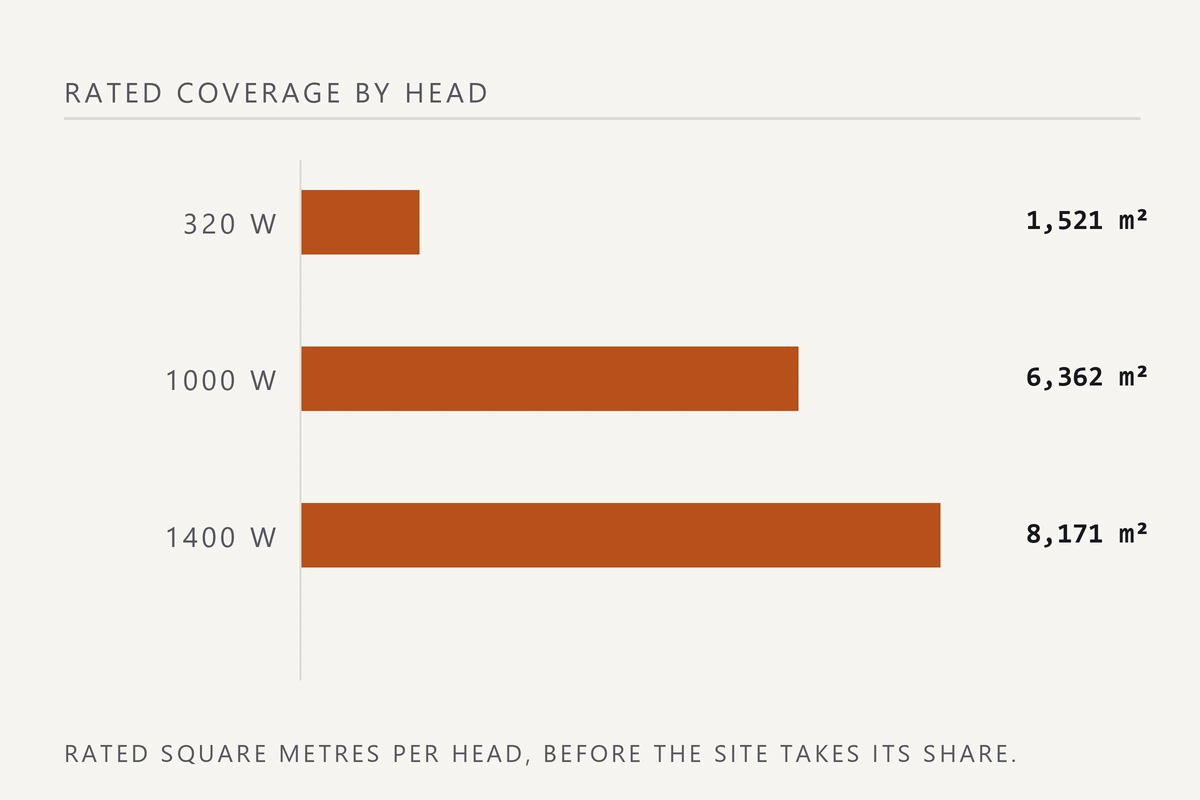
That is why the figure climbs in steps rather than smoothly. The tripod range runs from a 60 W head rated at 452 m² to a 1400 W head rated at 8,171 m², and the steps follow the lumens rather than the wattage, because output and area are the two ends of the same calculation.
Work back from the task
Coverage is easier to use the other way round. Decide the level the task needs, multiply it by the area, and compare the answer with the output of the head on the sheet. The arithmetic is rough, and it is the only honest way to size a tower before anyone has seen the site.
A worked example from the sheet: 165,000 lm spread over 4,000 m² is about 41 lux, which is enough for a yard and not enough for a live lane. The same head over 2,000 m² is back over 80 lux. Nothing about the lamp changed. The area did.
Task levels move the answer much further than wattage does. A yard at 50 lux and a pit at 200 lux are the same ground lit four times over, so a brief that starts with a lamp model rather than with a level usually buys twice.
The range, read honestly
| Head | Output | Rated coverage | Balloon | Head weight |
|---|---|---|---|---|
| 60 W | 9,600 lm | 452 m² | 40 x 25 cm | 1.9 kg |
| 320 W | 51,200 lm | 1,521 m² | 60 x 38 cm | 6.3 kg |
| 600 W | 96,000 lm | 3,848 m² | 64 x 39 cm | 8.4 kg |
| 1000 W | 165,000 lm | 6,362 m² | 100 x 56 cm | 11.4 kg |
| 1400 W | 224,000 lm | 8,171 m² | 100 x 66 cm | 12.8 kg |
Read down the column and the heads grow as well as brighten: the 600 W head carries a 64 cm balloon and the 1000 W head a 100 cm one, so a step up in output is also a step up in the size of the source. That is the part a buyer feels on site, because two heads at the same level are not the same light when one of them is a small source driven hard.
One head or two
Two 320 W heads on opposite sides of an area usually beat one 600 W head in the middle of it. The output is close, but the shadows are not: a single source doubles the depth of every shadow behind a kerb, a pipe or a person, and a work face lit from one direction reads flat.
The trade is deployment. Two heads mean two masts, two ballast points and two trips from the vehicle, and the second head only pays when the area is wide enough for the shadow to matter. A narrow yard with one work face is a one head job, and saying so is part of the advice.
Height changes the footprint
The same head on a 2.8 m tripod puts its light into a smaller, brighter pool than it does on a 4.8 m mast. Height is the tool that converts output into area, and it is also the part that decides glare: a head at eye level is uncomfortable at ten metres and the same head three metres higher is not.
The tripods run from 2.0 m to 4.8 m with load ratings from 20 kg to 80 kg, so the tallest mast is not the answer for every head. Pick the support from the head weight and the working height together, and check the wind rating with the head mounted before the mast goes up rather than after.
What to send with the enquiry
- The area, in metres across, or a sketch with two dimensions on it.
- The level the task needs, and whether it is a work face or a walkway.
- The hours of the shift, so the power is sized with the light rather than after it.
- The surface, because sand, fresh asphalt and a slope take different supports.
- The obstructions: a wall, a canopy, or plant that will stand in the light.
Those five answers choose the head and the mount before any wattage is discussed, and they are also what a supplier needs to quote one unit instead of a range. The 1000 W head and the 1400 W head are the two the arithmetic lands on for a yard or a compound, and the difference between them is usually the shadow problem rather than the area.
Coverage is a rated area, not a measured one. The site takes its share: a wall, a slope, a wet surface and a shadow all cost light, so plan a margin instead of spending the rating exactly.
Updated 2026-10-26 · 4 min read. Specifications change without notice; confirm the current sheet before you publish a claim or write a tender document.
Questions that come back
Short answers, before the email.
How much area does a 1000 W balloon light cover?
The sheet rates it at 6,362 m² at a working level. The same head over half that area roughly doubles the level, so the area only means something with the level beside it.
How many towers do I need for a yard?
Start from the level, multiply by the area, and compare with the head output. A wide area with a shadow problem usually wants two smaller heads, and a single work face wants one.
Is a taller mast always better?
No. Height trades glare against a tighter pool of light, and the support has to be rated for the head at that working height.
Does the coverage figure include losses?
It is a rated area at a rated level. Weather, a wet surface and an obstacle all take a share, so leave a margin rather than planning to the exact number.
Why do two heads beat one larger head?
Shadows. Two sources from opposite sides fill each other's shadows, and the level across the work face is more even than one larger source can make it.
Send the site, get the configuration.
Head, mount, power and the specification sheet for each line item, in one reply.