IP54 vs IP66: what the two digits buy a site light
An IP rating is two decisions written as two digits. The first is solids and the second is water, and on a site most of the argument is about the second one, because the first one is settled by a filter and a service interval.
Two digits, two questions
The first digit describes solids, the second describes water, and a rating is written with both. It applies to an assembled item tested to a stated method, which is why the same board can carry two different numbers in two different housings, and why a rating is quoted per model rather than per range.
That last point is the one buyers skip. A number on a page is a statement about the item that was tested, not about the family it belongs to, and a request for the test report for the exact model is the only way to keep the two together.
The first digit: 5 and 6 are different promises
A 5 means dust protected: dust gets in, in a quantity that does not stop the item working. A 6 means dust tight: no ingress at all. On a dusty site that difference is a service interval rather than a failure, because a head that lets a little dust in still lights, and the dust that costs output sits on the diffuser and in the filter until somebody cleans it.
The balloon line is built to be cleaned rather than sealed for life. It carries a replaceable filter for exactly that reason, and the maintenance routine treats the filter as a service part rather than as an accessory somebody remembers to order.
The second digit: 4 is a splash, 6 is a jet
A 4 means splashing water from any direction does no harm. A 6 means a powerful jet aimed at the enclosure does not get inside. Between those two numbers sits the whole difference between a head that survives a wet night and a head that survives being washed at the end of a shift.
The gap is not a small one. Splashing water arrives with almost no pressure, and a jet arrives with the pressure of a hose and a nozzle, which is why the two are separate test conditions rather than two settings of the same one.
Two of the five
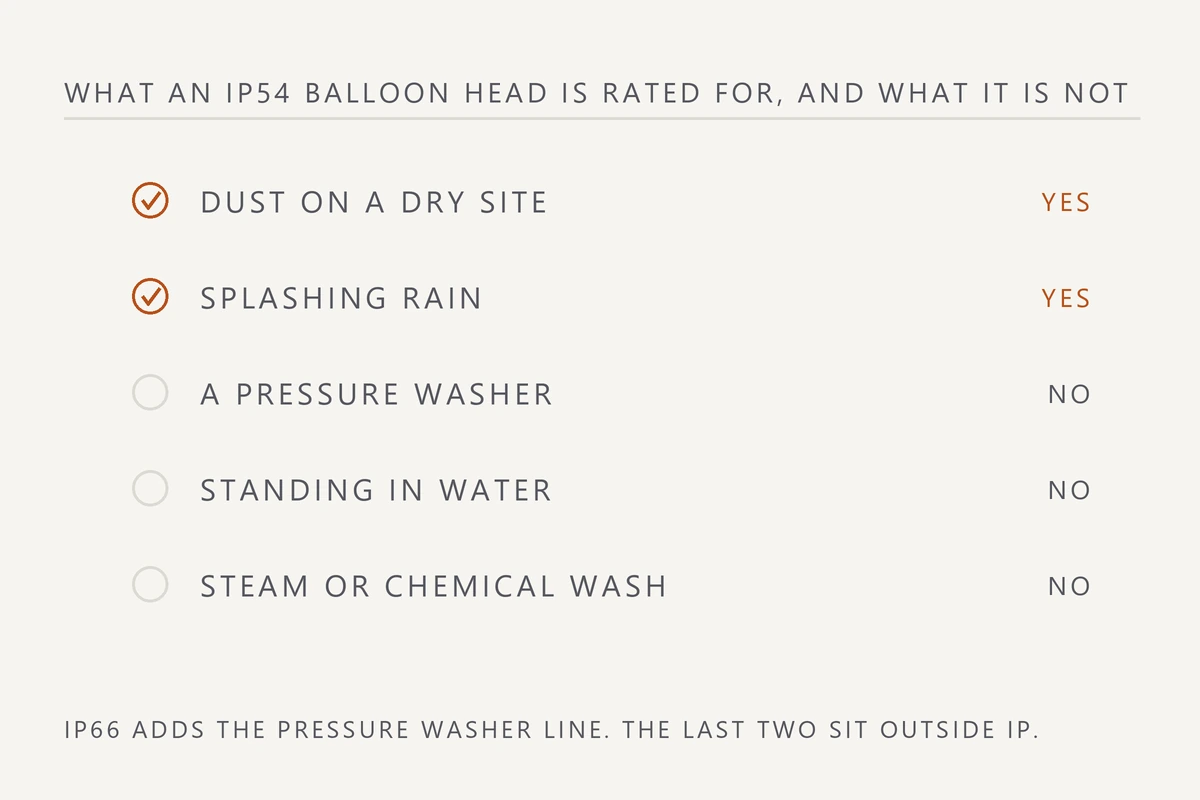
List the exposures a site actually applies and the arithmetic is short. Dust on a dry site and splashing rain are inside IP54. A pressure washer is not, and the IP66 floodlight head is the one that answers that line. Standing in water and a steam or chemical wash sit outside this part of the standard altogether, so no second digit answers them and no supplier should suggest otherwise.
Where the two heads sit
| Exposure | IP54 balloon head | IP66 floodlight head |
|---|---|---|
| Dust on a dry site | Rated, and the filter is a service part | Rated, and dust tight |
| Splashing rain | Rated | Rated |
| A pressure washer | Not rated | Rated |
| Standing in water | Not rated | Not rated |
| Steam or chemical wash | Not rated | Not rated |
The third row is the one that decides a purchase. A site that washes its equipment at the end of every shift is buying the floodlight head for the washing as much as for the beam, and a site that never washes anything is paying for a number it will not use.
Why a balloon head is IP54
A balloon head inflates. The diffuser is a fabric that has to fill, and a diffuser that fills is not a sealed panel, so the head is rated for what it is rather than for an ideal it cannot reach. The fabric is also the reason the light is soft, a large source at four metres being what removes the glare, and a sealed hard box would not be a balloon.
The floodlight head is the other shape of product: a lens on a housing with a gasket and no fabric, which is why the line that runs from 500 W to 1500 W carries IP66. Neither number is the better product. They are two answers to two jobs, and the range sells both because sites need both.
What to write into the brief
- The exposure, as a verb: rained on, hosed, pressure washed, or none of the three.
- The cleaning method, because the pressure washer is the line that splits the two ratings.
- Where the unit sleeps, because a damp container undoes a rating slowly and quietly.
- The test report for the exact model, because a rating belongs to an item and not to a family.
- The filter and the diffuser on the same order as the heads, because both are consumables.
Where the number stops
A rating describes a test, not a duty cycle. It does not say how many wet seasons a head lasts, it does not cover a punctured diffuser, and it does not cover a cable gland left loose after a repair. The two digits are a floor the product is built to, and the maintenance is what keeps it at that floor.
That is why the honest answer to whether a balloon light is waterproof is a number and a caveat. IP54 covers splashing rain and dust. It does not cover a jet, and repeating the claim louder does not change the test.
Two digits, two questions. The second digit is the one a pressure washer asks, and it is the one that decides the purchase.
Updated 2026-10-30 · 4 min read. Specifications change without notice; confirm the current sheet before you publish a claim or write a tender document.
Questions that come back
Short answers, before the email.
Are balloon lights waterproof?
The balloon heads are rated IP54, which covers dust and splashing water. That is a wet night, not a hose, and it is not a pressure washer.
Is IP66 better than IP54?
It is better at water under pressure and no worse at dust. For a soft light over a work face the rating is not the reason to choose the head, and a balloon still wins on glare at the same coverage.
Can an IP54 balloon head be pressure washed?
No. The rating stops at splashing, and a jet is a different test. Wash the diffuser by hand and let it dry before the head goes back in its bag.
What do the two digits in IP54 mean?
The 5 is solids: dust protected, so dust enters but not enough to stop the unit working. The 4 is water: splashing from any direction does no harm.
Which rating does a site light need?
The one that matches how the unit is cleaned. A head that is rained on wants splashing protection. A head that is washed with a hose wants the jet rating, and that is the floodlight line.
Send the site, get the configuration.
Head, mount, power and the specification sheet for each line item, in one reply.