Buy or rent a light tower: count the nights, not the jobs
A hire rate is easy to read because it is one number for one night. Ownership is a year of small numbers, and the two only become comparable once the weeks the tower stands idle are in the sum.
Count nights, not jobs
A light tower earns when it is lit. A hire agreement charges from the day the unit leaves the yard to the day it comes back, which includes the weekend it sat in a container, while a purchase charges from the day the invoice is paid, which includes every week it does nothing at all.
So the first figure to write down is not the number of jobs but the number of nights. A crew that lights a work face four nights a week through a season is a different customer from one that lights a single event and hands the unit back on Monday, and the two should not read the same quotation the same way.
The lines that appear when you own it
- Transport: the tower has to reach the site and come back, on a vehicle that can carry it, with the mast down and the balloon protected.
- Dry storage: a balloon and a diffuser are fabric and film, and a damp container is a slow way to lose output.
- Service parts: the filter and the diffuser are consumables, and one spare set on the shelf is the difference between one night and one week.
- The power source: a 1000 Wh or 2000 Wh station has a working life, and a generator has a service interval and a fuel can.
- Labour: setup and take down are paid twice on an owned unit, once to put it up and once to bring it in.
- The end of the job: an owned tower is resold or stored, and a hired one is handed back at the gate.
The lines a hire desk hides
Hire is not the absence of cost, it is a different shape of it. Delivery and collection are usually charged, the damage waiver is a line, fuel is either full to full or a charge, and the weekend is charged whether the tower works or not.
The line that never appears on a rate sheet is availability. On the night a storm takes a roof off, the tower already standing in the yard is worth more than the one that is booked until Thursday. That is a service argument rather than a financial one, and it is usually the argument that settles the question for a crew that keeps its own fleet.
Six signals, four and two
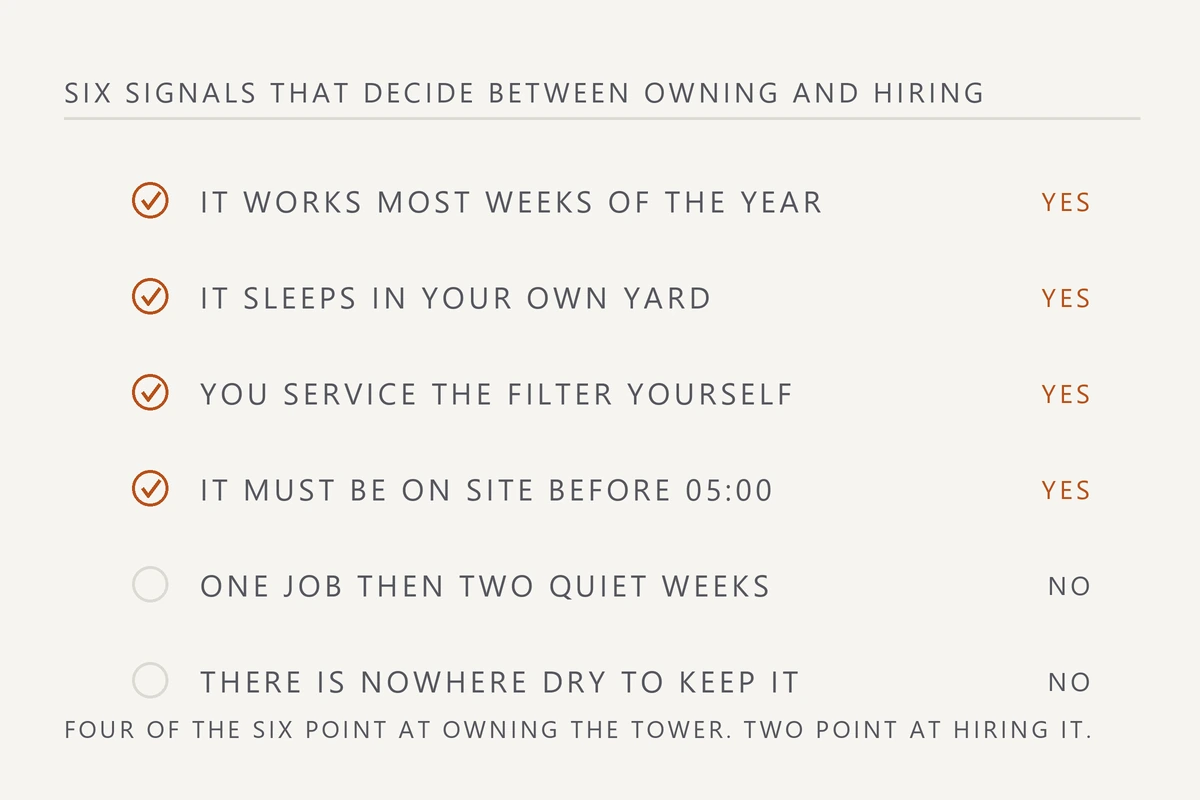
The four that pass are about pattern rather than size: work that comes most weeks, a place to keep the unit dry, a site that can change a filter, and a job that starts before a hire desk opens. The two that fail are the same signals read the other way, which is one job followed by a quiet fortnight, and nowhere dry to keep it.
Only one of the six is about money, and it is not the one people argue about. The night count decides the shape of the sum, and the storage answer decides whether owning is even available as an option.
What owning asks of a site
The tripod line is the one a single person handles: a 1000 W head at 11.4 kg or a 1400 W head at 12.8 kg, on a mast from 2.0 m to 4.8 m, with the legs folding for transport. The mobile carts are heavier and stand on stabilisers, and the large cart takes a footprint of its own rather than a parking space.
Owning also makes the maintenance calendar yours. On a dusty site the filter is cleaned weekly, the diffuser is checked for punctures before a shift, and the battery is charged between jobs rather than when somebody remembers. None of that is difficult, and all of it is work that a hire desk does not send an invoice for because it was never going to be done by you.
The six lines of the arithmetic
| Line | When you own | When you hire |
|---|---|---|
| Nights used | Counted once, carried all year | Charged from collection to return |
| Transport | Your vehicle and your fuel | On the delivery note |
| Storage | Dry space you give up | Somebody else's yard |
| Service and spares | Yours, including the filter | In the rate, not in the van |
| Two in the morning | The unit is in the yard | Whatever the depot has free |
| End of the job | Resold or stored | Handed back at the gate |
Read down the two columns and the pattern is that hire turns a capital cost into a cost per night with a floor, while ownership turns a cost per night into a fixed cost with a ceiling. Neither is cheaper in the abstract. The night count decides which of the two applies, and the storage answer decides whether the cheaper one is available to you.
The night count decides the question and the storage answer decides whether it is a question at all. Everything else in the sum is a rounding error on those two.
Updated 2026-10-29 · 4 min read. Specifications change without notice; confirm the current sheet before you publish a claim or write a tender document.
Questions that come back
Short answers, before the email.
Is hiring cheaper for a short job?
It depends on how short. One job, two weeks and nowhere dry to keep a tower is the pattern that hire is built for, because the fixed costs of ownership have nothing to spread across.
What wears out first on an owned tower?
The consumables. The filter clogs on a dusty site, the diffuser is punctured in transport, and a battery loses capacity on a calendar rather than on a counter.
Can one person set up a balloon light tower?
On the tripod line, yes: the heads are 11.4 kg and 12.8 kg and the mast is a manual lift. The mobile carts are heavier, stand on stabilisers, and ask for two people and a level footprint.
Do I need a generator as well as a battery?
Only if the site has no charging window. A 1000 Wh station runs the smaller lamps for a shift, and a 2000 Wh station covers a medium lamp for about six hours. The largest lamps want the generator.
How long should a tower last?
That belongs in writing with the warranty terms rather than in a guide, so ask for the warranty period and what it covers on the lamp, the mast and the power source separately.
Send the site, get the configuration.
Head, mount, power and the specification sheet for each line item, in one reply.