RGBW balloon light for events: white, colour and the schedule
An event moves through five lighting conditions in one evening, and the fixture that covers all five does not have to be five fixtures. A balloon with red, green, blue and a dedicated 3000 K white channel gives the warm wash over the tables and the colour on the trees from the same head, which is why hire fleets standardise on it.
White is a channel, not a mix
An RGB fixture makes white by adding three colours and hoping the result reads neutral. It usually does not, especially on skin and on white linen, and the giveaway is a photograph with a green or magenta cast that the client notices before anyone notices the light.
The RGBW head carries a separate 3000 K white string, so the warm white is produced rather than mixed. That is the difference between a fixture that can light a dinner service and a fixture that can only colour a wall. It also means the white setting is the one to test first, because it is the setting a venue will use for the longest part of the night.
The evening has five looks
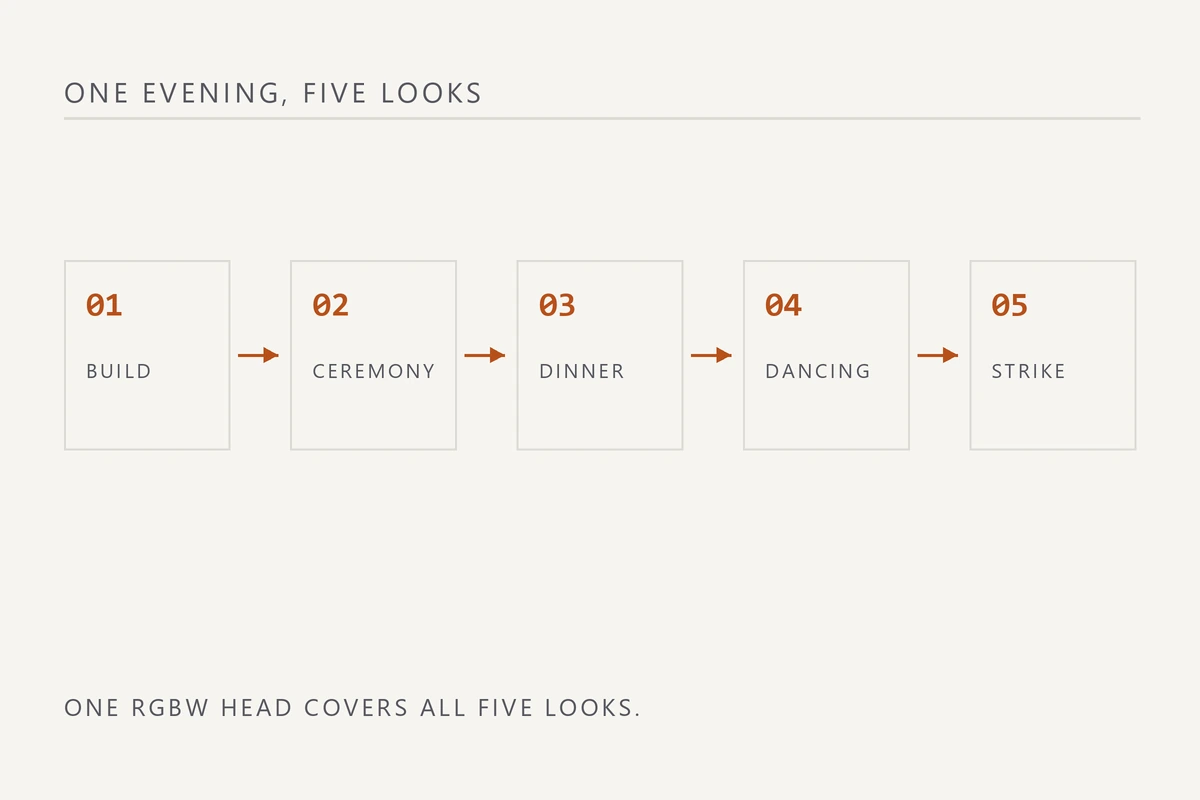
The schedule is the brief, not the product. Build in daylight with the white channel at full, so a fault shows before the guests arrive. Ceremony in white, dimmed, with the balloon high enough that it reads as a glow rather than a lamp. Dinner at 3000 K, which sits beside candles and tungsten practicals without turning the table cloth green. Dancing in colour, with the white low or off so the room does not fight the palette. Strike after the last guest, with the balloon dry before it is packed.
One head covers all five. What changes between them is the channel, the level and the height, and on a DMX desk the same five looks are five cues rather than five fixtures. A venue that books the same room every week will ask for exactly that arrangement, because the crew sets the desk once and repeats it.
Balloon size against the venue
The wattage decides the balloon: 100 cm at 100 W and 130 cm at 200 W. The balloon decides the quality of the light, because a larger source wraps further around a face or a table, and the size decides the space the unit needs. A 130 cm balloon in a low marquee reads as an oversized prop and puts the diffuser within reach of a guest, which is a design question rather than a lighting one.
| Model | Output | Balloon | White | Suits |
|---|---|---|---|---|
| 100 W | 14,000 lm | 100 cm | 3000 K | A terrace, a small marquee, a garden |
| 200 W | 28,000 lm | 130 cm | 3000 K | A lawn, a stage front, a larger venue |
Power, cable and where it stands
Both heads run on AC 100 to 277 V and 50/60 Hz, so the venue's supply is a socket question rather than a voltage question. The cable is the part that gets forgotten. A run across a lawn needs a route a guest will not trip over, and a run into a marquee needs the entry point agreed with the marquee crew before the fixture is placed, not after the tables are set.
The mast matters as much as the head. A 4.8 m mast gives the balloon height and a longer throw of light, and the load rating of the tripod has to carry the head that goes on it. On grass or gravel, ballast and a level patch come before the second fixture, and the tripod range carries the height and the load for each size.
IP54 covers dust and splashing water, which is what a summer evening in a field produces. It is not a storm rating. A balloon in rising wind comes down whatever the IP number says, and a diffuser packed away wet is a separate problem that shows up at the next event.
Control, and the one conflict to plan for
Control is a 2.4 GHz remote, a button on the housing and, on the models sold for stage and hire work, DMX512. Brightness, colour and the speed of the dynamic modes are all adjustable, and the DMX option has to be specified at order because it is not a switch in the firmware.
The conflict to plan for is radio. A venue running wireless microphones on 2.4 GHz and a fixture remote on the same band can have a bad night, and the fix is a different band or a wired console. Ask for the remote frequency with the quotation and check it against the audio kit the venue already owns.
What a hire fleet should stock
- One SKU rather than two: white and colour from the same balloon halves the stock a trailer carries.
- The DMX option on the units that go to venues with a lighting desk.
- A spare filter, because the housing has a dust and insect filter that fills up outdoors.
- Two balloon sizes, so a low marquee and a lawn are both covered by the same order.
The 200 W RGBW balloon is the one that covers a lawn and a stage front, and the 100 W version is the one that fits a terrace and goes up with one person. A fleet that buys only the larger unit will send it to jobs that did not need it, and a fleet that buys only the smaller one will turn work down.
The fabric is UV resistant and flame retardant, and that is a property to ask for in writing rather than to assume. An events client will ask for it, and the answer belongs in the file, not in the conversation on the night.
Updated 2026-10-25 · 4 min read. Specifications change without notice; confirm the current sheet before you publish a claim or write a tender document.
Questions that come back
Short answers, before the email.
Can the white channel run on its own?
Yes. It is a separate 3000 K string, so the head works as a warm white fixture with no colour mixed in, and that is the setting dinner service uses.
Is 100 W enough for a marquee?
It is the terrace and small marquee size, at 14,000 lm from a 100 cm balloon. A larger tent, a lawn or a stage front is the 200 W unit, which doubles the output and grows the balloon to 130 cm.
Does it work in rain?
The head is IP54, which covers dust and splashing water. A balloon in rising wind comes down, and a diffuser packed away wet is a separate problem.
Do I need DMX?
Only if the venue runs a lighting desk. The remote and the housing button cover a private event, and the DMX option is an order time decision rather than something added later.
Can the balloon appear in photographs?
Yes. The fabric sphere reads as a practical, so the same unit can light a scene and sit inside it, which is harder to do with a panel and a frame.
Send the site, get the configuration.
Head, mount, power and the specification sheet for each line item, in one reply.